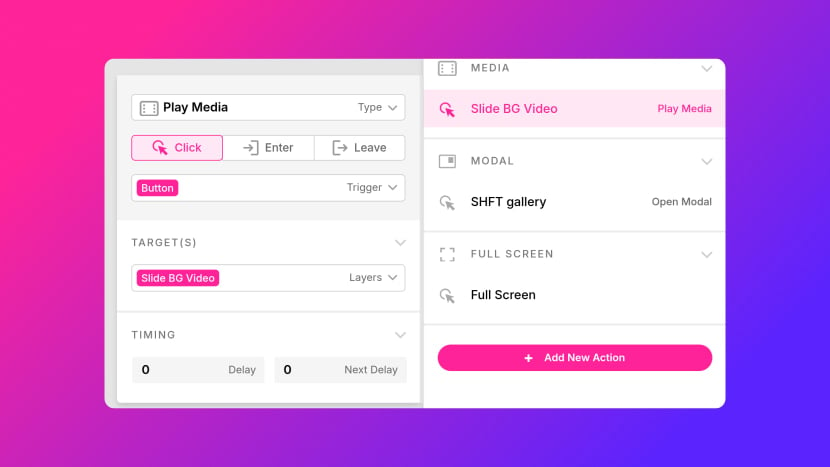
Media Actions
UI Navigation Map: Media actions

In the Right Sidebar click the Action icon to enter Action Mode, click Add New Action, then in the Action Settings Panel open the Type dropdown and choose an action from the Media group:
- Media Actions
- Open Lightbox Panel
- Type
- Event
- Trigger
- Lightbox Section
- Gallery
- Alt Text as Caption
- Timing Section
- Delay
- Next Delay
- Play Media Panel
- Type
- Event
- Trigger
- Target(s) Section
- Layers
- Timing Section
- Delay
- Next Delay
- Stop Media Panel
- Type
- Event
- Trigger
- Target(s) Section
- Layers
- Timing Section
- Delay
- Next Delay
- Toggle Media Panel
- Type
- Event
- Trigger
- Target(s) Section
- Layers
- Timing Section
- Delay
- Next Delay
- Mute Media Panel
- Type
- Event
- Trigger
- Target(s) Section
- Layers
- Timing Section
- Delay
- Next Delay
- Unmute Media Panel
- Type
- Event
- Trigger
- Target(s) Section
- Layers
- Timing Section
- Delay
- Next Delay
- Toggle Mute Media Panel
- Type
- Event
- Trigger
- Target(s) Section
- Layers
- Timing Section
- Delay
- Next Delay
- Restart Media Panel
- Type
- Event
- Trigger
- Target(s) Section
- Layers
- Timing Section
- Delay
- Next Delay
- Jump to Time Panel
- Type
- Event
- Trigger
- Target(s) Section
- Layers
- Time Section
- Jump To
- Timing Section
- Delay
- Next Delay
- Set Volume Panel
- Type
- Event
- Trigger
- Target(s) Section
- Layers
- Volume Section
- Volume
- Timing Section
- Delay
- Next Delay
- Open Lightbox Panel
An action makes something happen when a visitor interacts with a layer, such as a click on a button. Actions are set up in Action Mode, one of the three modes of the Module Editor's Right Sidebar.
The Media actions control audio and video layers. They start, stop and restart playback, switch sound on and off, move playback to a chosen time, and set the volume. A button can then act as a custom control for a video or an audio track.
The Open Lightbox action shows an image or video large, over the page, with arrows to the module's other lightbox images and videos.
This article covers the ten Media actions and every setting in their panels.
To set one up, go to the Module Editor and click the Action icon 1 in the Mode Switcher of the Right Sidebar to enter Action Mode.
Then click Add New Action 2, which opens the Action Settings Panel.
Open the Type dropdown 3 and choose an action from the Media group.
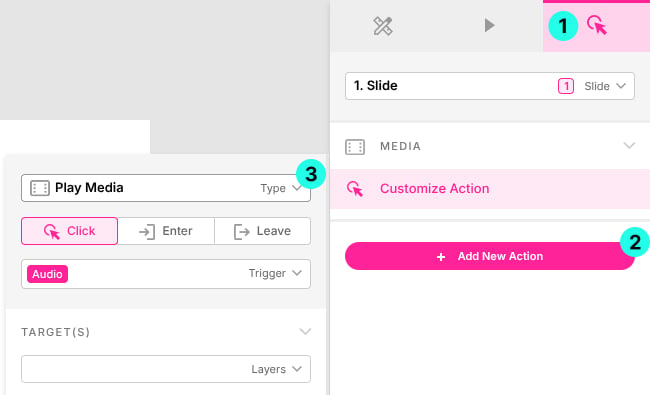
An action is added to the slide shown in the editor, and runs from the layers chosen in its Trigger.
Open Lightbox Panel
The Open Lightbox panel configures which layers open a lightbox, and which other images and videos the lightbox can move to. A lightbox shows an image or video large, over the page.
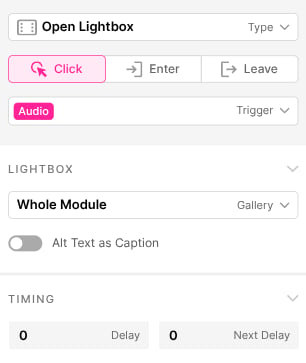
A click on an image or video layer with this action shows that layer's image or video in the lightbox. The image enlarges from the layer's position to the lightbox size, and shrinks back into the layer when the lightbox closes.
The lightbox closes on the Esc key, its close button, or a click beside the image. A slideshow that is running pauses while the lightbox is open, and continues after it closes.
HTML5, YouTube and Vimeo videos play inside the lightbox. A click on a video layer with this action opens the lightbox and does not start or stop the video on the slide.
With the layer's cursor set to Inherit, the pointer shows a zoom cursor over a layer with this action. The lightbox's own files load on the first click, so a module that is never clicked loads nothing extra.
Type (Dropdown)
Sets which action is performed when the trigger fires. Choosing Open Lightbox from the Media group of the list gives this panel.

Event (Tab Select)
Sets which visitor interaction with the trigger layers opens the lightbox.

Options:
- Click: Opens the lightbox when a trigger layer is clicked or tapped.
- Enter: Opens the lightbox when the pointer moves over a trigger layer.
- Leave: Opens the lightbox when the pointer moves off a trigger layer.
Trigger (Multi-select)
Selects the layer or layers that open the lightbox. The list is searchable, and any number of the current slide's layers can be selected.

An image or video layer opens its own image or video. A layer without an image or video of its own, such as a button, opens the first image or video within the reach set by Gallery.
Lightbox Section (Expander)
In the Lightbox section choose which other images and videos the lightbox can move to, and whether a caption is shown.
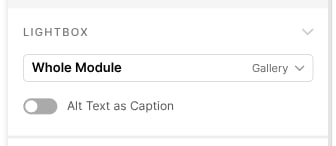
Gallery (Dropdown)
Setting Visibility
- Visible when Lightbox section is expanded.
- Hidden when Lightbox section is collapsed.
Sets which layers' images and videos the Open Lightbox arrows can reach. Every layer with an Open Lightbox action is part of the gallery. The default is Whole Module.

With more than one image or video in reach, the lightbox shows Previous and Next arrows and a counter, such as 2 / 5. The arrow keys and a swipe also move between them.
The order is slide by slide, and within a slide from left to right, then top to bottom. For a layer without an image or video of its own, the reach also includes the slide backgrounds and every image and video layer, with or without an action.
Options:
- Whole Module: The arrows reach every lightbox layer in the module.
- This Slide: The arrows reach the lightbox layers on the same slide.
- Only This One: No arrows. The lightbox shows this layer's image or video only. On a layer without an image or video of its own, it shows those of its slide.
Alt Text as Caption (Toggle)
Setting Visibility
- Visible when Lightbox section is expanded.
- Hidden when Lightbox section is collapsed.
Sets whether the layer's alt text is shown as a caption under the image in the lightbox. The default is On.

Options:
- On: The alt text is shown under the image.
- Off: No caption.
Timing Section (Expander)
In the Timing section set the pauses that surround the action, so that a sequence of actions can be staggered rather than all firing at once.
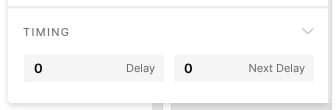
Delay (Number, milliseconds)
Setting Visibility
- Visible when Timing section is expanded.
- Hidden when Timing section is collapsed.
Sets how long to wait after the event fires before the lightbox opens. A value of 0 runs it immediately.
Next Delay (Number, milliseconds)
Setting Visibility
- Visible when Timing section is expanded.
- Hidden when Timing section is collapsed.
Sets a pause measured from this action, before the next action on the same trigger runs.
Play Media Panel
The Play Media panel configures which audio or video layers start playing, and what starts them.
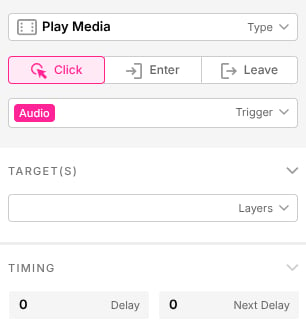
Type (Dropdown)
Sets which action is performed when the trigger fires. Choosing Play Media from the Media group of the list gives this panel.

Event (Tab Select)
Sets which visitor interaction with the trigger layers plays the media.

Options:
- Click: Plays the media when a trigger layer is clicked or tapped.
- Enter: Plays the media when the pointer moves over a trigger layer.
- Leave: Plays the media when the pointer moves off a trigger layer.
Trigger (Multi-select)
Selects the layer or layers that play the media. The list is searchable, and any number of the current slide's layers can be selected.

Target(s) Section (Expander)
In the Target(s) section choose the media layers the action applies to.
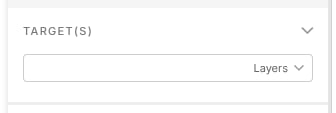
Layers (Multi-select)
Setting Visibility
- Visible when Target(s) section is expanded.
- Hidden when Target(s) section is collapsed.
Selects the media layer or layers to play.
The list is searchable. Under General Video Layers, Slide BG Video targets the slide's background video, and Active Video in Slide targets the first video layer of the slide being shown.
Below that, Current Slide Layers lists the audio and video layers of the current slide, and Static Slide Layers those of the static slide, whose layers appear on top of every slide. Other layer types are not listed.

Timing Section (Expander)
In the Timing section set the pauses that surround the action, so that a sequence of actions can be staggered rather than all firing at once.
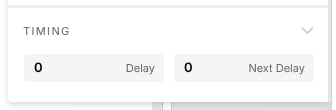
Delay (Number, milliseconds)
Setting Visibility
- Visible when Timing section is expanded.
- Hidden when Timing section is collapsed.
Sets how long to wait after the event fires before the media plays. A value of 0 runs it immediately.
Next Delay (Number, milliseconds)
Setting Visibility
- Visible when Timing section is expanded.
- Hidden when Timing section is collapsed.
Sets a pause measured from this action, before the next action on the same trigger runs.
Stop Media Panel
The Stop Media panel configures which audio or video layers stop playing, and what stops them. Stopped media is paused at its current position, so playing it again continues from there.
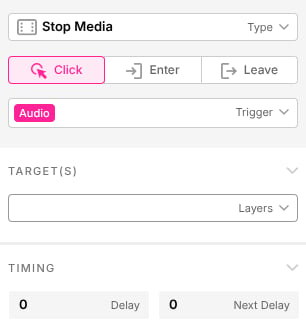
Type (Dropdown)
Sets which action is performed when the trigger fires. Choosing Stop Media from the Media group of the list gives this panel.

Event (Tab Select)
Sets which visitor interaction with the trigger layers stops the media.

Options:
- Click: Stops the media when a trigger layer is clicked or tapped.
- Enter: Stops the media when the pointer moves over a trigger layer.
- Leave: Stops the media when the pointer moves off a trigger layer.
Trigger (Multi-select)
Selects the layer or layers that stop the media. The list is searchable, and any number of the current slide's layers can be selected.

Target(s) Section (Expander)
In the Target(s) section choose the media layers the action applies to.
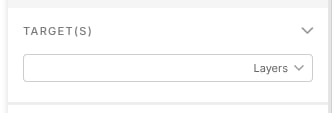
Layers (Multi-select)
Setting Visibility
- Visible when Target(s) section is expanded.
- Hidden when Target(s) section is collapsed.
Selects the media layer or layers to stop.
The list is searchable. Under General Video Layers, Slide BG Video targets the slide's background video, and Active Video in Slide targets the first video layer of the slide being shown.
Below that, Current Slide Layers lists the audio and video layers of the current slide, and Static Slide Layers those of the static slide, whose layers appear on top of every slide. Other layer types are not listed.

Timing Section (Expander)
In the Timing section set the pauses that surround the action, so that a sequence of actions can be staggered rather than all firing at once.
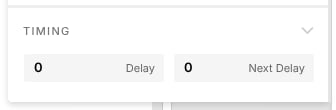
Delay (Number, milliseconds)
Setting Visibility
- Visible when Timing section is expanded.
- Hidden when Timing section is collapsed.
Sets how long to wait after the event fires before the media stops. A value of 0 runs it immediately.
Next Delay (Number, milliseconds)
Setting Visibility
- Visible when Timing section is expanded.
- Hidden when Timing section is collapsed.
Sets a pause measured from this action, before the next action on the same trigger runs.
Toggle Media Panel
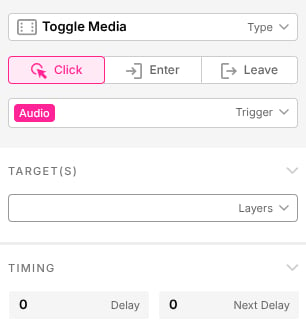
The Toggle Media panel configures audio or video layers that switch between playing and stopped. Each time the action runs, media that is playing is paused, and media that is not playing starts.
Type (Dropdown)
Sets which action is performed when the trigger fires. Choosing Toggle Media from the Media group of the list gives this panel.

Event (Tab Select)
Sets which visitor interaction with the trigger layers switches the media between playing and stopped.

Options:
- Click: Switches the media between playing and stopped when a trigger layer is clicked or tapped.
- Enter: Switches the media between playing and stopped when the pointer moves over a trigger layer.
- Leave: Switches the media between playing and stopped when the pointer moves off a trigger layer.
Trigger (Multi-select)
Selects the layer or layers that switch the media between playing and stopped. The list is searchable, and any number of the current slide's layers can be selected.

Target(s) Section (Expander)
In the Target(s) section choose the media layers the action applies to.
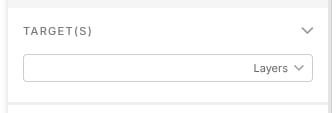
Layers (Multi-select)
Setting Visibility
- Visible when Target(s) section is expanded.
- Hidden when Target(s) section is collapsed.
Selects the media layer or layers to switch between playing and stopped.
The list is searchable. Under General Video Layers, Slide BG Video targets the slide's background video, and Active Video in Slide targets the first video layer of the slide being shown.
Below that, Current Slide Layers lists the audio and video layers of the current slide, and Static Slide Layers those of the static slide, whose layers appear on top of every slide. Other layer types are not listed.

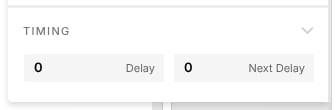
Timing Section (Expander)
In the Timing section set the pauses that surround the action, so that a sequence of actions can be staggered rather than all firing at once.
Delay (Number, milliseconds)
Setting Visibility
- Visible when Timing section is expanded.
- Hidden when Timing section is collapsed.
Sets how long to wait after the event fires before the media switches. A value of 0 runs it immediately.
Next Delay (Number, milliseconds)
Setting Visibility
- Visible when Timing section is expanded.
- Hidden when Timing section is collapsed.
Sets a pause measured from this action, before the next action on the same trigger runs.
Mute Media Panel
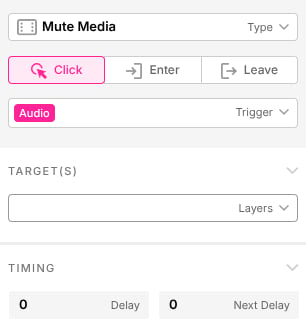
The Mute Media panel configures which audio or video layers have their sound switched off, and what mutes them. The media keeps playing without sound.
Type (Dropdown)
Sets which action is performed when the trigger fires. Choosing Mute Media from the Media group of the list gives this panel.

Event (Tab Select)
Sets which visitor interaction with the trigger layers mutes the media.

Options:
- Click: Mutes the media when a trigger layer is clicked or tapped.
- Enter: Mutes the media when the pointer moves over a trigger layer.
- Leave: Mutes the media when the pointer moves off a trigger layer.
Trigger (Multi-select)
Selects the layer or layers that mute the media. The list is searchable, and any number of the current slide's layers can be selected.

Target(s) Section (Expander)
In the Target(s) section choose the media layers the action applies to.
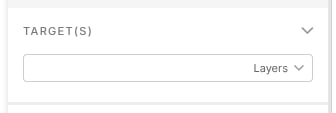
Layers (Multi-select)
Setting Visibility
- Visible when Target(s) section is expanded.
- Hidden when Target(s) section is collapsed.
Selects the media layer or layers to mute.
The list is searchable. Under General Video Layers, Slide BG Video targets the slide's background video, and Active Video in Slide targets the first video layer of the slide being shown.
Below that, Current Slide Layers lists the audio and video layers of the current slide, and Static Slide Layers those of the static slide, whose layers appear on top of every slide. Other layer types are not listed.

Timing Section (Expander)
In the Timing section set the pauses that surround the action, so that a sequence of actions can be staggered rather than all firing at once.
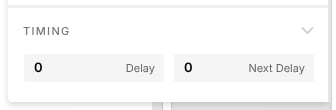
Delay (Number, milliseconds)
Setting Visibility
- Visible when Timing section is expanded.
- Hidden when Timing section is collapsed.
Sets how long to wait after the event fires before the media is muted. A value of 0 runs it immediately.
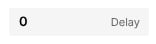
Next Delay (Number, milliseconds)
Setting Visibility
- Visible when Timing section is expanded.
- Hidden when Timing section is collapsed.
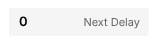
Sets a pause measured from this action, before the next action on the same trigger runs.
Unmute Media Panel
The Unmute Media panel configures which audio or video layers have their sound switched back on, and what unmutes them. An audio layer also starts playing when it is unmuted.
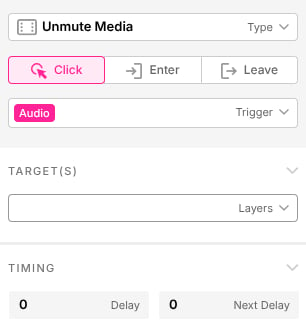
Type (Dropdown)
Sets which action is performed when the trigger fires. Choosing Unmute Media from the Media group of the list gives this panel.

Event (Tab Select)
Sets which visitor interaction with the trigger layers unmutes the media.

Options:
- Click: Unmutes the media when a trigger layer is clicked or tapped.
- Enter: Unmutes the media when the pointer moves over a trigger layer.
- Leave: Unmutes the media when the pointer moves off a trigger layer.
Trigger (Multi-select)
Selects the layer or layers that unmute the media. The list is searchable, and any number of the current slide's layers can be selected.

Target(s) Section (Expander)
In the Target(s) section choose the media layers the action applies to.
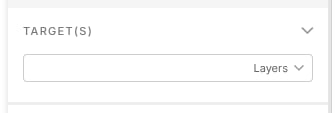
Layers (Multi-select)
Setting Visibility
- Visible when Target(s) section is expanded.
- Hidden when Target(s) section is collapsed.
Selects the media layer or layers to unmute.
The list is searchable. Under General Video Layers, Slide BG Video targets the slide's background video, and Active Video in Slide targets the first video layer of the slide being shown.
Below that, Current Slide Layers lists the audio and video layers of the current slide, and Static Slide Layers those of the static slide, whose layers appear on top of every slide. Other layer types are not listed.

Timing Section (Expander)
In the Timing section set the pauses that surround the action, so that a sequence of actions can be staggered rather than all firing at once.
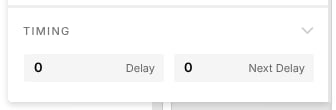
Delay (Number, milliseconds)
Setting Visibility
- Visible when Timing section is expanded.
- Hidden when Timing section is collapsed.
Sets how long to wait after the event fires before the media is unmuted. A value of 0 runs it immediately.
Next Delay (Number, milliseconds)
Setting Visibility
- Visible when Timing section is expanded.
- Hidden when Timing section is collapsed.
Sets a pause measured from this action, before the next action on the same trigger runs.
Toggle Mute Media Panel
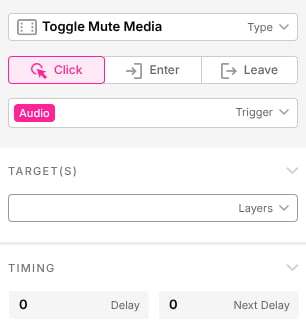
The Toggle Mute Media panel configures audio or video layers that switch between muted and unmuted. Each time the action runs, muted media is unmuted, and media with sound is muted. An audio layer that is not playing is unmuted and starts playing.
Type (Dropdown)
Sets which action is performed when the trigger fires. Choosing Toggle Mute Media from the Media group of the list gives this panel.

Event (Tab Select)
Sets which visitor interaction with the trigger layers switches the media between muted and unmuted.

Options:
- Click: Switches the media between muted and unmuted when a trigger layer is clicked or tapped.
- Enter: Switches the media between muted and unmuted when the pointer moves over a trigger layer.
- Leave: Switches the media between muted and unmuted when the pointer moves off a trigger layer.
Trigger (Multi-select)
Selects the layer or layers that switch the media between muted and unmuted. The list is searchable, and any number of the current slide's layers can be selected.

Target(s) Section (Expander)
In the Target(s) section choose the media layers the action applies to.
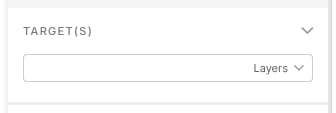
Layers (Multi-select)
Setting Visibility
- Visible when Target(s) section is expanded.
- Hidden when Target(s) section is collapsed.
Selects the media layer or layers to switch between muted and unmuted.
The list is searchable. Under General Video Layers, Slide BG Video targets the slide's background video, and Active Video in Slide targets the first video layer of the slide being shown.
Below that, Current Slide Layers lists the audio and video layers of the current slide, and Static Slide Layers those of the static slide, whose layers appear on top of every slide. Other layer types are not listed.

Timing Section (Expander)
In the Timing section set the pauses that surround the action, so that a sequence of actions can be staggered rather than all firing at once.
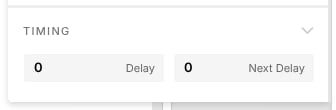
Delay (Number, milliseconds)
Setting Visibility
- Visible when Timing section is expanded.
- Hidden when Timing section is collapsed.
Sets how long to wait after the event fires before the media switches. A value of 0 runs it immediately.
Next Delay (Number, milliseconds)
Setting Visibility
- Visible when Timing section is expanded.
- Hidden when Timing section is collapsed.
Sets a pause measured from this action, before the next action on the same trigger runs.
Restart Media Panel
The Restart Media panel configures which audio or video layers play again from their start, and what restarts them. The media returns to the start time set on the media layer, or to its beginning when none is set, and plays from there.
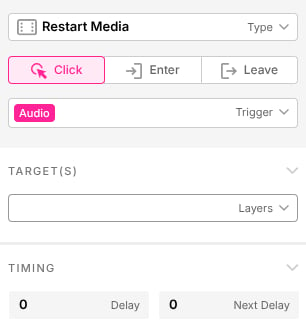
Type (Dropdown)
Sets which action is performed when the trigger fires. Choosing Restart Media from the Media group of the list gives this panel.

Event (Tab Select)
Sets which visitor interaction with the trigger layers restarts the media.

Options:
- Click: Restarts the media when a trigger layer is clicked or tapped.
- Enter: Restarts the media when the pointer moves over a trigger layer.
- Leave: Restarts the media when the pointer moves off a trigger layer.
Trigger (Multi-select)
Selects the layer or layers that restart the media. The list is searchable, and any number of the current slide's layers can be selected.

Target(s) Section (Expander)
In the Target(s) section choose the media layers the action applies to.
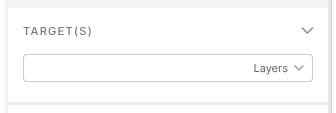
Layers (Multi-select)
Setting Visibility
- Visible when Target(s) section is expanded.
- Hidden when Target(s) section is collapsed.
Selects the media layer or layers to restart.
The list is searchable. Under General Video Layers, Slide BG Video targets the slide's background video, and Active Video in Slide targets the first video layer of the slide being shown.
Below that, Current Slide Layers lists the audio and video layers of the current slide, and Static Slide Layers those of the static slide, whose layers appear on top of every slide. Other layer types are not listed.

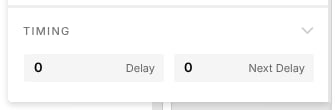
Timing Section (Expander)
In the Timing section set the pauses that surround the action, so that a sequence of actions can be staggered rather than all firing at once.
Delay (Number, milliseconds)
Setting Visibility
- Visible when Timing section is expanded.
- Hidden when Timing section is collapsed.
Sets how long to wait after the event fires before the media restarts. A value of 0 runs it immediately.
Next Delay (Number, milliseconds)
Setting Visibility
- Visible when Timing section is expanded.
- Hidden when Timing section is collapsed.
Sets a pause measured from this action, before the next action on the same trigger runs.
Jump to Time Panel
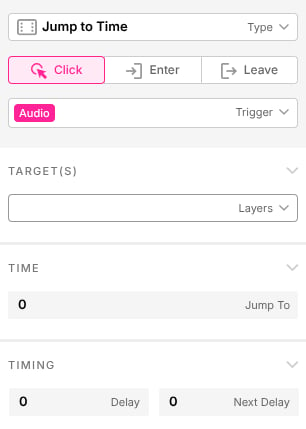
The Jump to Time panel configures which audio or video layers move to a chosen point in their playback, and what moves them.
Type (Dropdown)
Sets which action is performed when the trigger fires. Choosing Jump to Time from the Media group of the list gives this panel.

Event (Tab Select)
Sets which visitor interaction with the trigger layers moves the media to the chosen time.

Options:
- Click: Moves the media to the chosen time when a trigger layer is clicked or tapped.
- Enter: Moves the media to the chosen time when the pointer moves over a trigger layer.
- Leave: Moves the media to the chosen time when the pointer moves off a trigger layer.
Trigger (Multi-select)
Selects the layer or layers that move the media to the chosen time. The list is searchable, and any number of the current slide's layers can be selected.

Target(s) Section (Expander)
In the Target(s) section choose the media layers the action applies to.
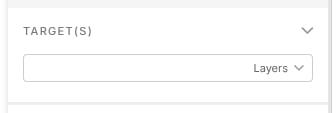
Layers (Multi-select)
Setting Visibility
- Visible when Target(s) section is expanded.
- Hidden when Target(s) section is collapsed.
Selects the media layer or layers to move to the chosen time.
The list is searchable. Under General Video Layers, Slide BG Video targets the slide's background video, and Active Video in Slide targets the first video layer of the slide being shown.
Below that, Current Slide Layers lists the audio and video layers of the current slide, and Static Slide Layers those of the static slide, whose layers appear on top of every slide. Other layer types are not listed.

Time Section (Expander)
In the Time section set the point in the media to move to.
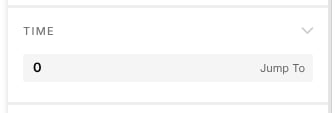
Jump To (Number, seconds, range)
Setting Visibility
- Visible when Time section is expanded.
- Hidden when Time section is collapsed.
Sets the time to move to, in seconds from the beginning of the media. It counts from the media's own beginning, not from a start time set on the media layer.

Options:
- 0: Minimum. Moves to the beginning of the media.
- 99999: Maximum.
Timing Section (Expander)
In the Timing section set the pauses that surround the action, so that a sequence of actions can be staggered rather than all firing at once.
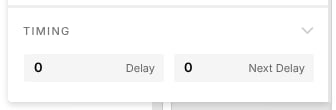
Delay (Number, milliseconds)
Setting Visibility
- Visible when Timing section is expanded.
- Hidden when Timing section is collapsed.
Sets how long to wait after the event fires before the media moves. A value of 0 runs it immediately.
Next Delay (Number, milliseconds)
Setting Visibility
- Visible when Timing section is expanded.
- Hidden when Timing section is collapsed.
Sets a pause measured from this action, before the next action on the same trigger runs.
Set Volume Panel
The Set Volume panel configures which audio or video layers change to a chosen volume, and what changes it.
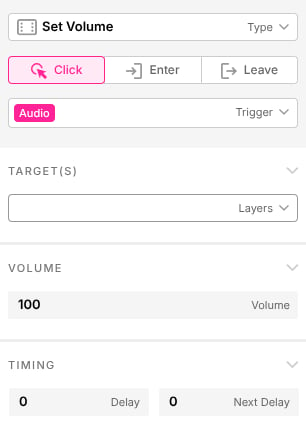
Type (Dropdown)
Sets which action is performed when the trigger fires. Choosing Set Volume from the Media group of the list gives this panel.

Event (Tab Select)
Sets which visitor interaction with the trigger layers sets the volume.

Options:
- Click: Sets the volume when a trigger layer is clicked or tapped.
- Enter: Sets the volume when the pointer moves over a trigger layer.
- Leave: Sets the volume when the pointer moves off a trigger layer.
Trigger (Multi-select)
Selects the layer or layers that set the volume. The list is searchable, and any number of the current slide's layers can be selected.

Target(s) Section (Expander)
In the Target(s) section choose the media layers the action applies to.
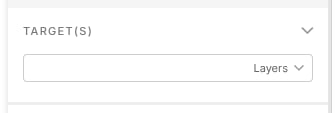
Layers (Multi-select)
Setting Visibility
- Visible when Target(s) section is expanded.
- Hidden when Target(s) section is collapsed.
Selects the media layer or layers whose volume is set.
The list shows every layer, not only audio and video layers, and the action has no effect on a layer without media. It groups the layers of the current slide under Current Slide Layers, and those of the static slide, whose layers appear on top of every slide, under Static Slide Layers.

Volume Section (Expander)
In the Volume section set the volume level.
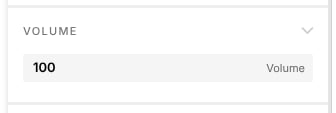
Volume (Number, percentage, range)
Setting Visibility
- Visible when Volume section is expanded.
- Hidden when Volume section is collapsed.
Sets the volume as a percentage of full volume. The same scale applies to every kind of media layer. A value above 0 also unmutes media that is muted.

Options:
- 0: Minimum. No sound.
- 100: Maximum. Full volume.
Timing Section (Expander)
In the Timing section set the pauses that surround the action, so that a sequence of actions can be staggered rather than all firing at once.
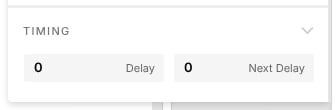
Delay (Number, milliseconds)
Setting Visibility
- Visible when Timing section is expanded.
- Hidden when Timing section is collapsed.
Sets how long to wait after the event fires before the volume changes. A value of 0 runs it immediately.
Next Delay (Number, milliseconds)
Setting Visibility
- Visible when Timing section is expanded.
- Hidden when Timing section is collapsed.
Sets a pause measured from this action, before the next action on the same trigger runs.